Augea
Augea Research · Retail Cost Index · Edition 2026-Q2 · Methodology v1

A 3.5× retail cost gap inside developed markets.

On a $500/month card-rail BTC dollar-cost-average, the difference between the cheapest and most expensive developed market tracked here compounds to roughly $210 per year. Every number is reproducible from public country-level snapshots, and the 3.5× framing must clear a fixed decision rule before it is used.

By Per Englund · Founder & Research Lead, Augea ResearchPublished 2026-04-21Next edition July 2026CC-BY-4.0
Headline finding · card rail · BTC · matched $100 baseline

3.50×

🇨🇦 Canada median card-rail cost is 3.50× 🇵🇱 Poland across this 10-country benchmark slice — with non-overlapping observed ranges.

🇨🇦 Canada median
4.90%
🇵🇱 Poland median
1.40%
Augea ResearchRetail Cost IndexEdition 2026-Q2Methodology v1Next edition: July 2026

The lens

The Augea Retail Cost Index measures what it actually costs a retail buyer to acquire crypto across markets, and only makes claims that clear a fixed decision rule.

This edition covers 10 developed markets and two payment rails (card and bank) on a matched $100 BTC baseline. Why it matters: rail choice and country routinely move retail buy costs more than exchange choice does.

Primary artifact · card rail

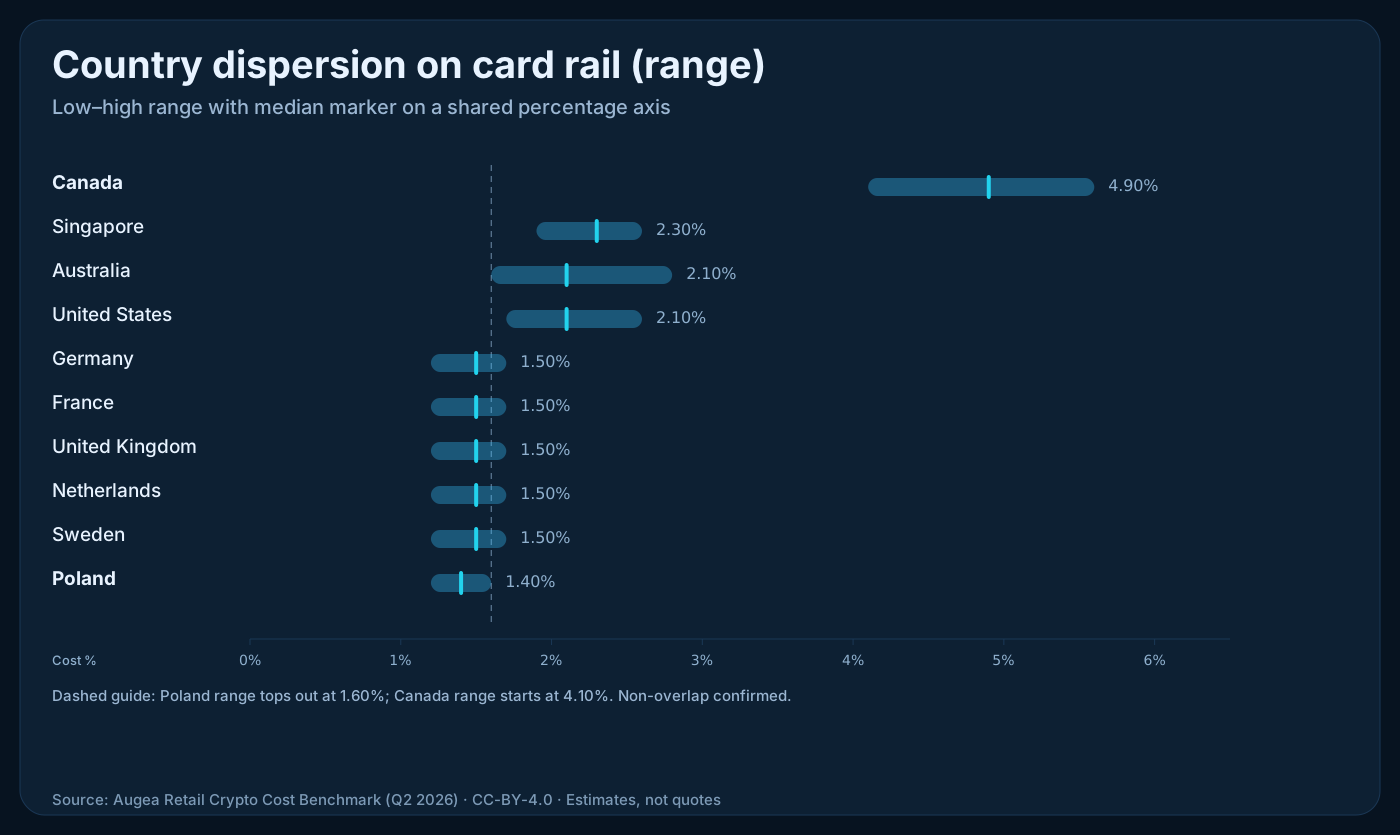
Card rail · BTC · matched $100 baseline · n=10

Canadian retail buyers pay 3.5× more than Polish buyers on card-rail BTC.

Country medians across 10 developed markets. Bars show the observed low–high range; dots mark country medians. Observed ranges between Canada and Poland do not overlap.

Compared pairOutlier · Canada 4.90%Low anchor · Poland 1.40%

Canada 4.90% vs Poland 1.40% = 3.50×

Absolute gap: +3.50% percentage points

OutlierLow anchorPeer cluster
Canada
Canada median 4.90%, observed range 4.10% to 5.60%
4.90%Outlier
9-country cluster · 1.40%2.30% medians
Singapore
Singapore median 2.30%, observed range 1.90% to 2.60%
2.30%
Australia
Australia median 2.10%, observed range 1.60% to 2.80%
2.10%
United States
United States median 2.10%, observed range 1.70% to 2.60%
2.10%
Germany
Germany median 1.50%, observed range 1.20% to 1.70%
1.50%
France
France median 1.50%, observed range 1.20% to 1.70%
1.50%
United Kingdom
United Kingdom median 1.50%, observed range 1.20% to 1.70%
1.50%
Netherlands
Netherlands median 1.50%, observed range 1.20% to 1.70%
1.50%
Sweden
Sweden median 1.50%, observed range 1.20% to 1.70%
1.50%
Poland
Poland median 1.40%, observed range 1.20% to 1.60%
1.40%Low anchor
0%
1%
2%
3%
4%
5%
6%

Median retail buy cost, % of $100 matched baseline
Source: Augea Retail Cost Index · Edition 2026-Q2 · Methodology v1 · n=10 developed markets · BTC card rail · $100 matched baseline · CC-BY-4.0
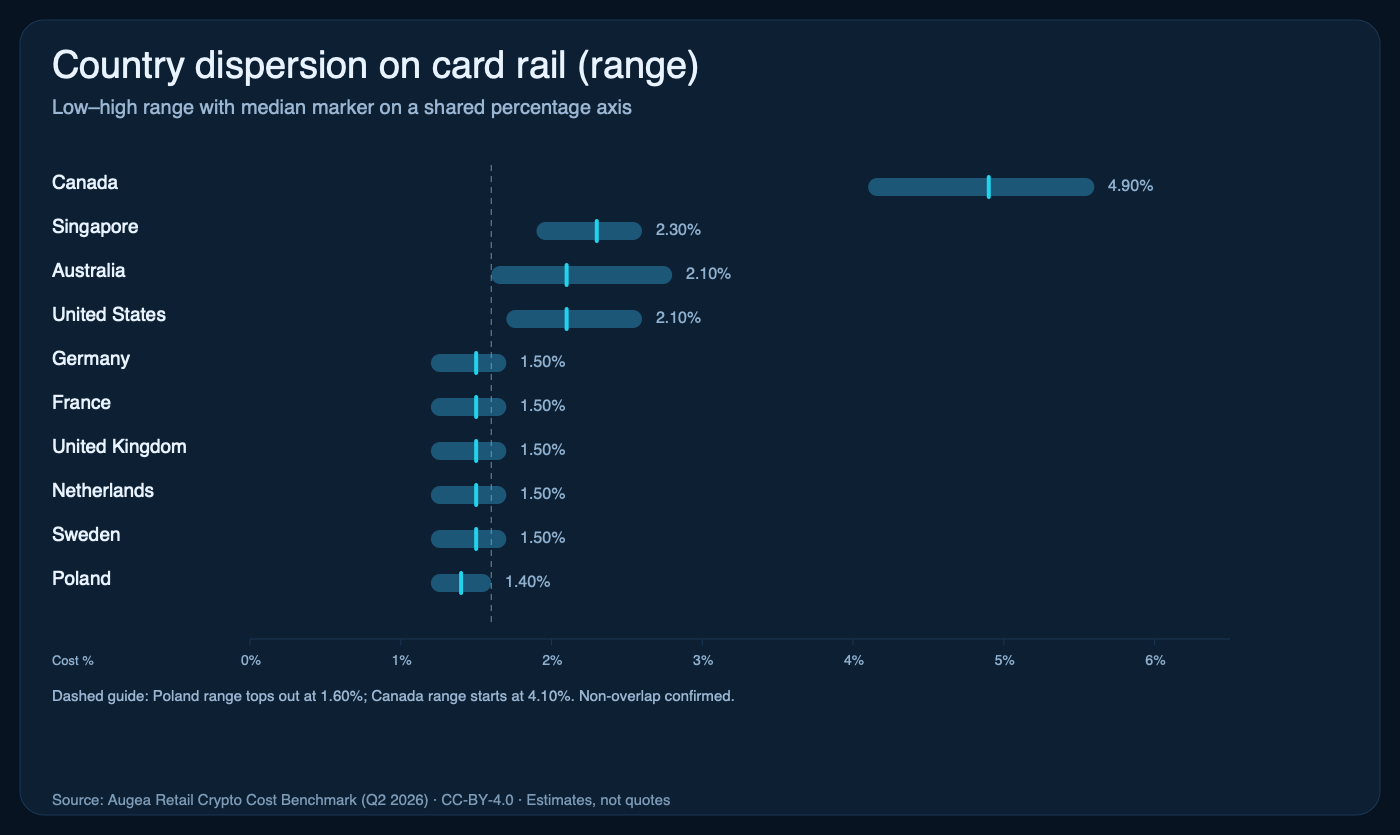
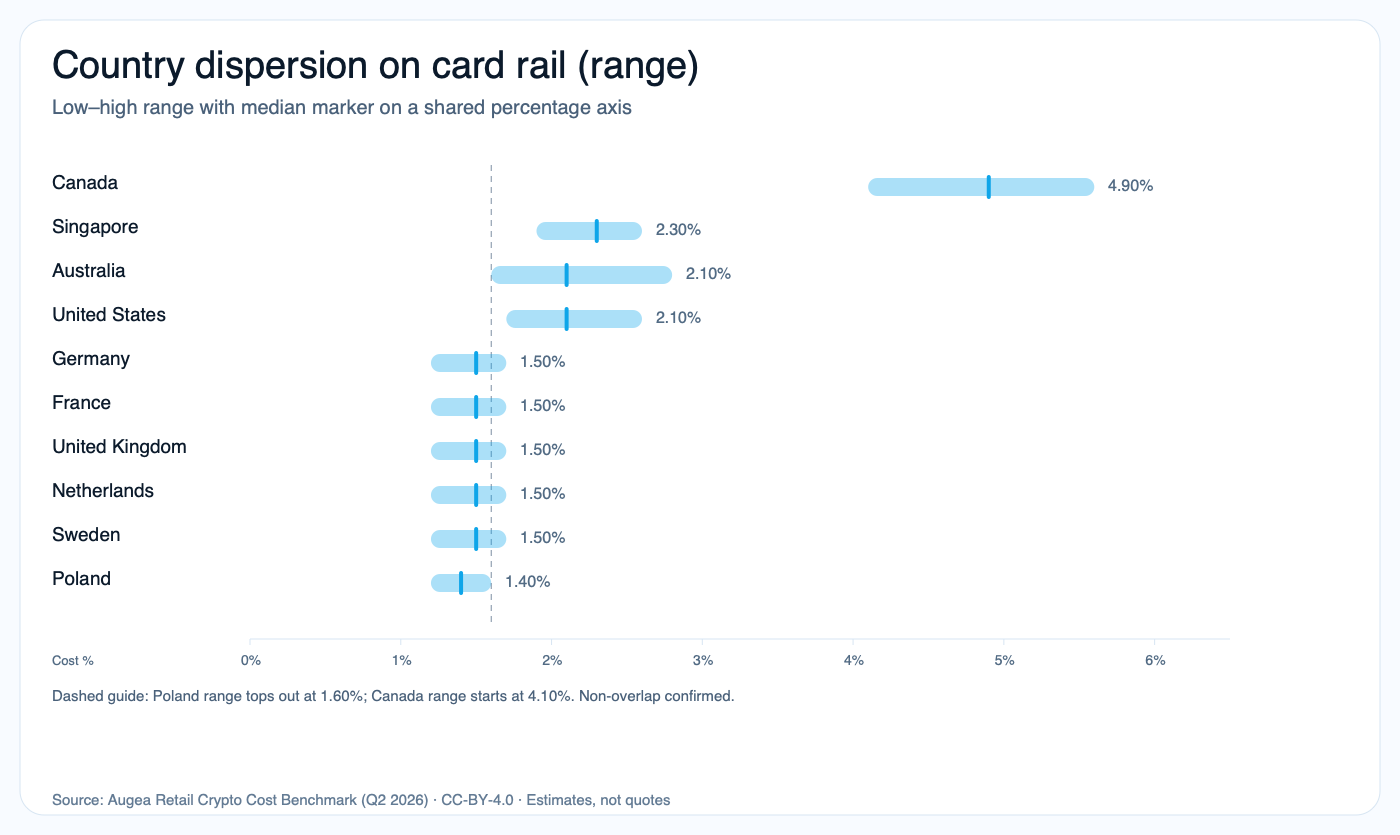
SVGPNG darkPNG whitealt · Card-rail cost ranges per country on a shared axis with median markers and non-overlap guide.

Three findings

Finding 1 · Country gap

Canada is 3.50× Poland on matched card medians.

Finding 2 · Rail gap

Card routes run 9.67× bank routes across country medians in this slice.

Finding 3 · Coverage

All 10 countries measured on both rails with 18 matched assets each.

Headline ratio

3.50×

Canada vs Poland · card rail

Coverage

10

countries · card routes 10 · bank routes 10

Comparable assets

18

per country for matched card and bank slices

What this means

The gap isn't about which exchange you pick. It's about where you buy from.

Retail users in different countries can face materially different estimated buy costs even when the base scenario is held constant. Country and payment rail often matter more than people expect.

The card-versus-bank gap is structurally consistent across countries in this slice. Card rails cluster around 2.03%; bank rails cluster around 0.21%. That holds even in countries where overall cost is well below the median.

This is a benchmark, not a price quote. It supports evidence-backed comparisons and route choices while staying out of causal claims about why the spread exists.

Claim boundary

Canada median card cost is 3.50× Poland in this benchmark slice (BTC, $100), with ranges 4.1%+ vs up to 1.6%.

Truth source: Live country summaries (card + bank) · Latest captured /cheapest snapshot (Q2 2026) · adapter cheapest-country-summary-truth/v1

What this proves

  • Cross-country retail buy-cost dispersion is visible in the live country summaries.
  • Card and bank rails show materially different country-level medians.
  • The selected headline ratio is reproducible from published country medians.

What this does not prove

  • Do not claim causality from this benchmark alone.
  • Do not claim the ratio holds for all amounts, assets, or future snapshots.
  • Do not present these values as guaranteed execution prices.

Country benchmark tables

Card railMedianRange
Canada4.90%4.10%5.60%
Singapore2.30%1.90%2.60%
Australia2.10%1.60%2.80%
United States2.10%1.70%2.60%
Germany1.50%1.20%1.70%
Bank railMedianRange
Canada0.30%0.30%0.80%
Australia0.20%0.20%0.20%
Germany0.20%0.10%0.20%
France0.20%0.10%0.20%
United Kingdom0.20%0.20%0.20%

Secondary views · Chart pack

Supporting views of the same benchmark slice for republish and download. The primary analytical artifact is the dispersion chart above; maps appear here as geographic context and share assets rather than as the lead read.

Rail split · country detail

Selected pair comparison

On-site summary of the claim-gated pair at $100 baseline. Use the press page for the hero stat card export.

Canada

4.90% · $4.90 on $100

Poland

1.40% · $1.40 on $100

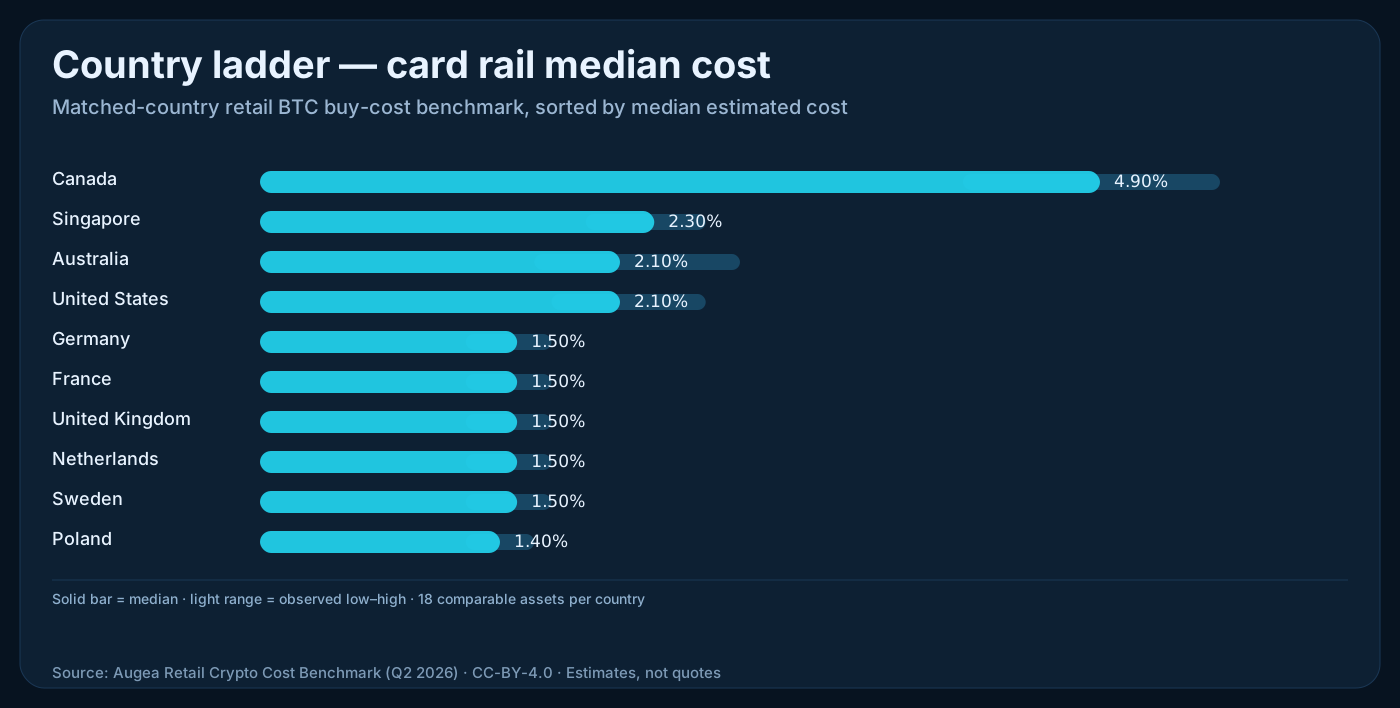
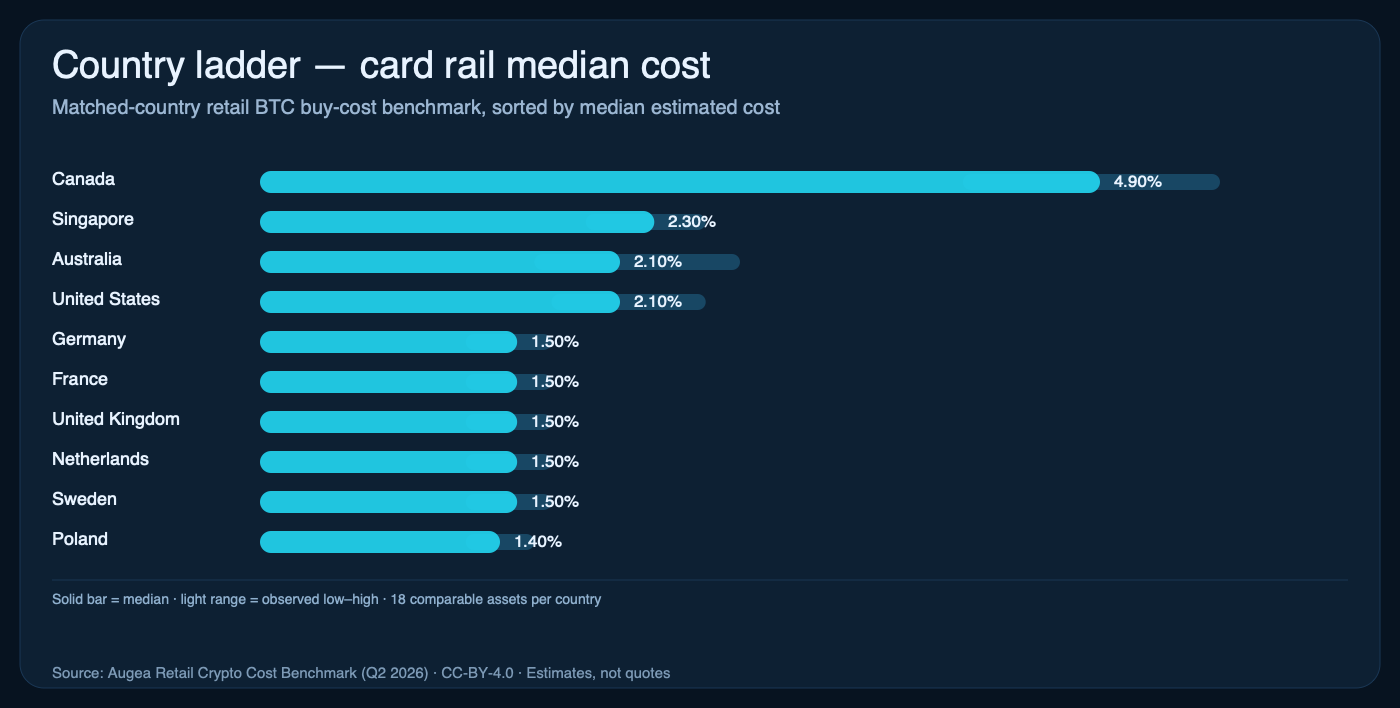
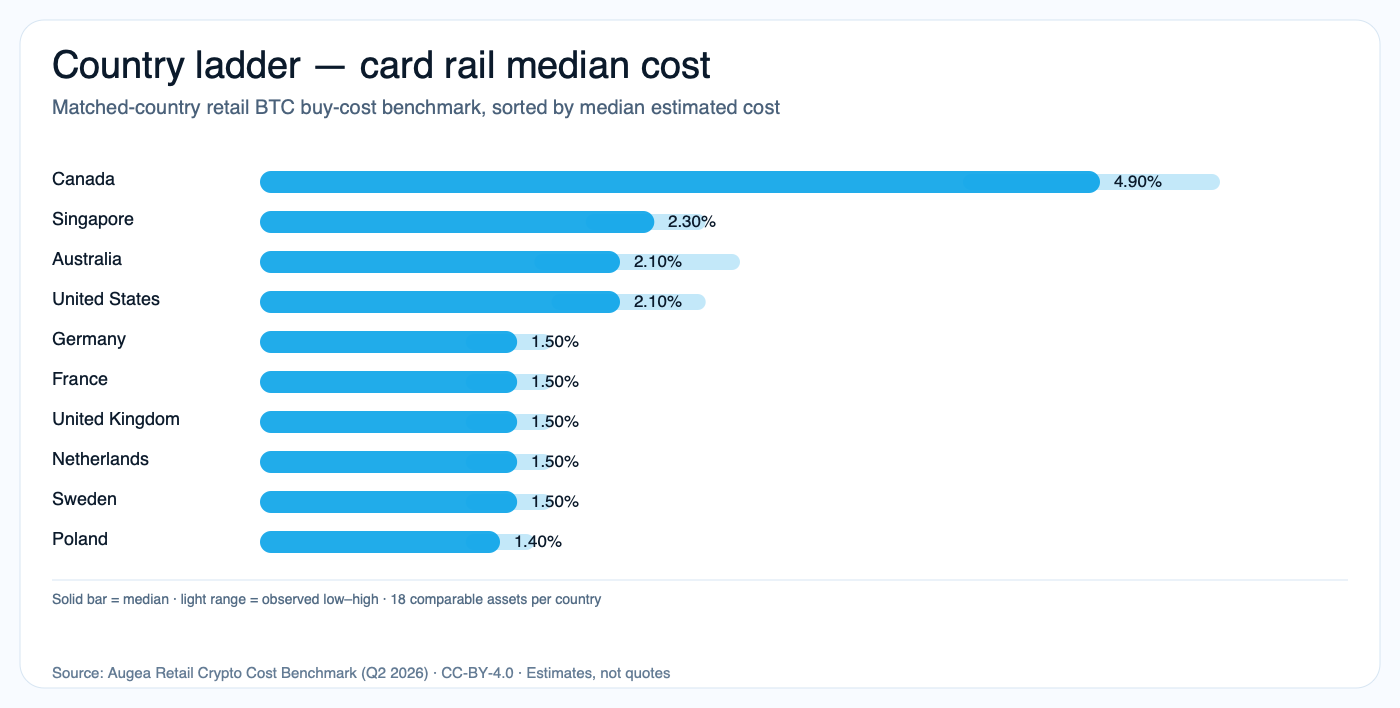
Country ladder (card rail)

Country medians for card routes in this benchmark slice.

  • Canada
    4.90%
  • Singapore
    2.30%
  • Australia
    2.10%
  • United States
    2.10%
  • Germany
    1.50%
  • France
    1.50%
  • United Kingdom
    1.50%
  • Netherlands
    1.50%
  • Sweden
    1.50%
  • Poland
    1.40%

Solid bar = median · light range = observed low–high · 18 comparable assets per country

SVGPNG darkPNG whitealt · Country medians ranked by card-rail cost with observed range.

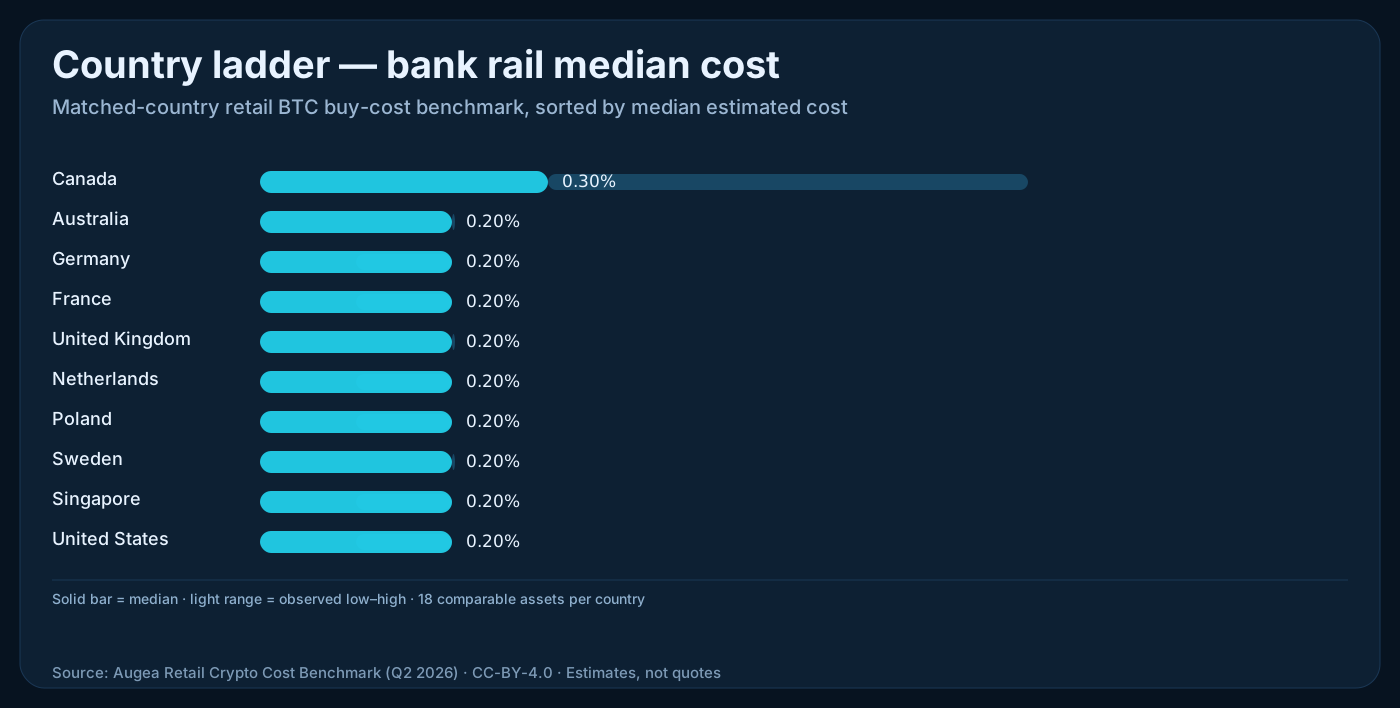
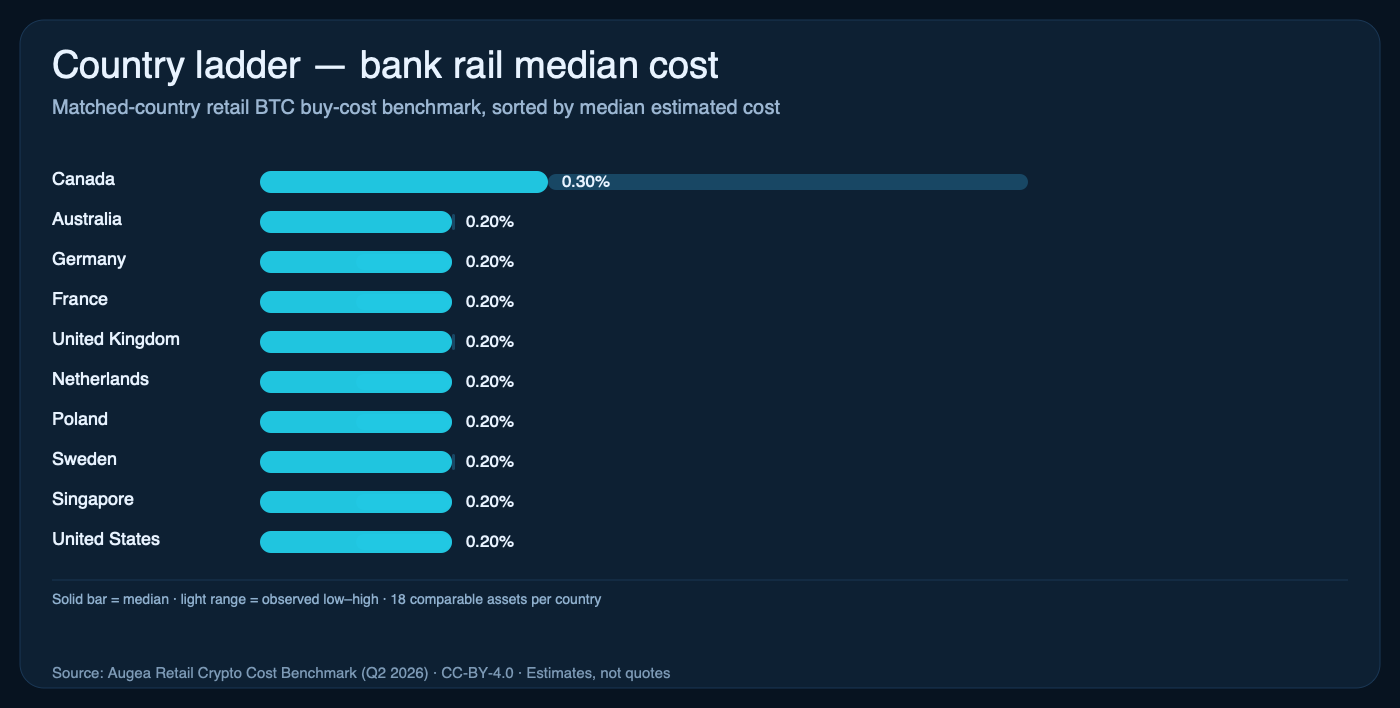
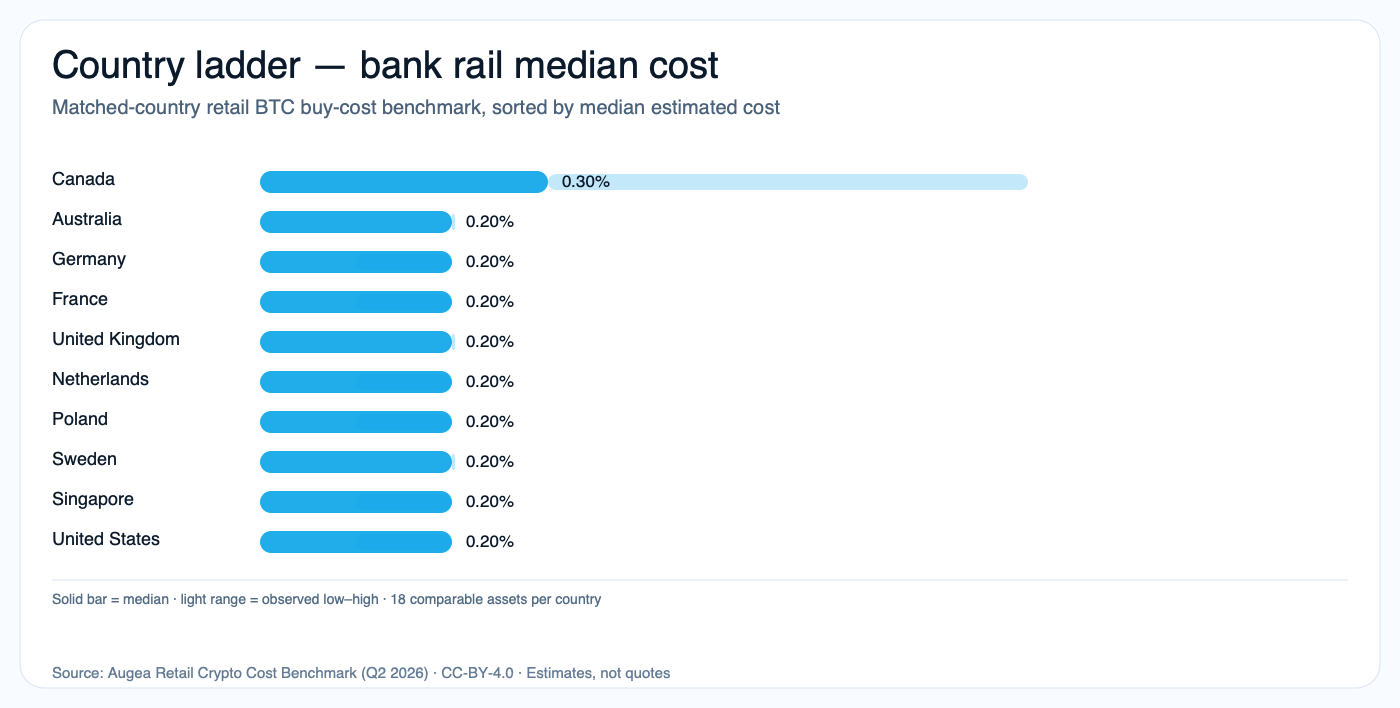
Country ladder (bank rail)

Country medians for bank routes in this benchmark slice.

  • Canada
    0.30%
  • Australia
    0.20%
  • Germany
    0.20%
  • France
    0.20%
  • United Kingdom
    0.20%
  • Netherlands
    0.20%
  • Poland
    0.20%
  • Sweden
    0.20%
  • Singapore
    0.20%
  • United States
    0.20%

Solid bar = median · light range = observed low–high · 18 comparable assets per country

SVGPNG darkPNG whitealt · Country medians ranked by bank-rail cost with observed range.

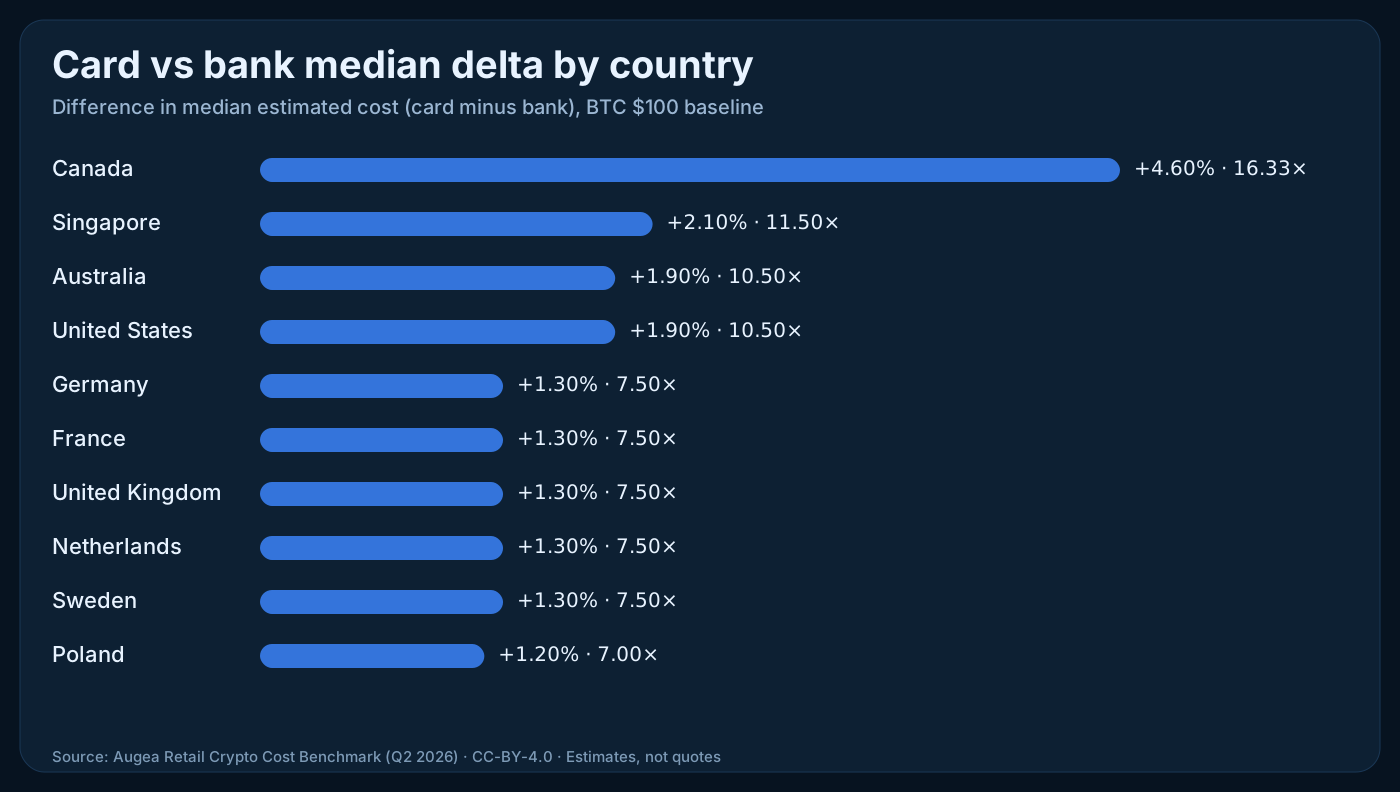
Card vs bank delta by country

Percentage-point difference between card and bank median costs within each country.

  • Canada
    +4.60%
  • Singapore
    +2.10%
  • Australia
    +1.90%
  • United States
    +1.90%
  • Germany
    +1.30%
  • France
    +1.30%
  • United Kingdom
    +1.30%
  • Netherlands
    +1.30%
  • Sweden
    +1.30%
  • Poland
    +1.20%
SVGPNG darkPNG whitealt · Percentage-point card-vs-bank median delta per country.

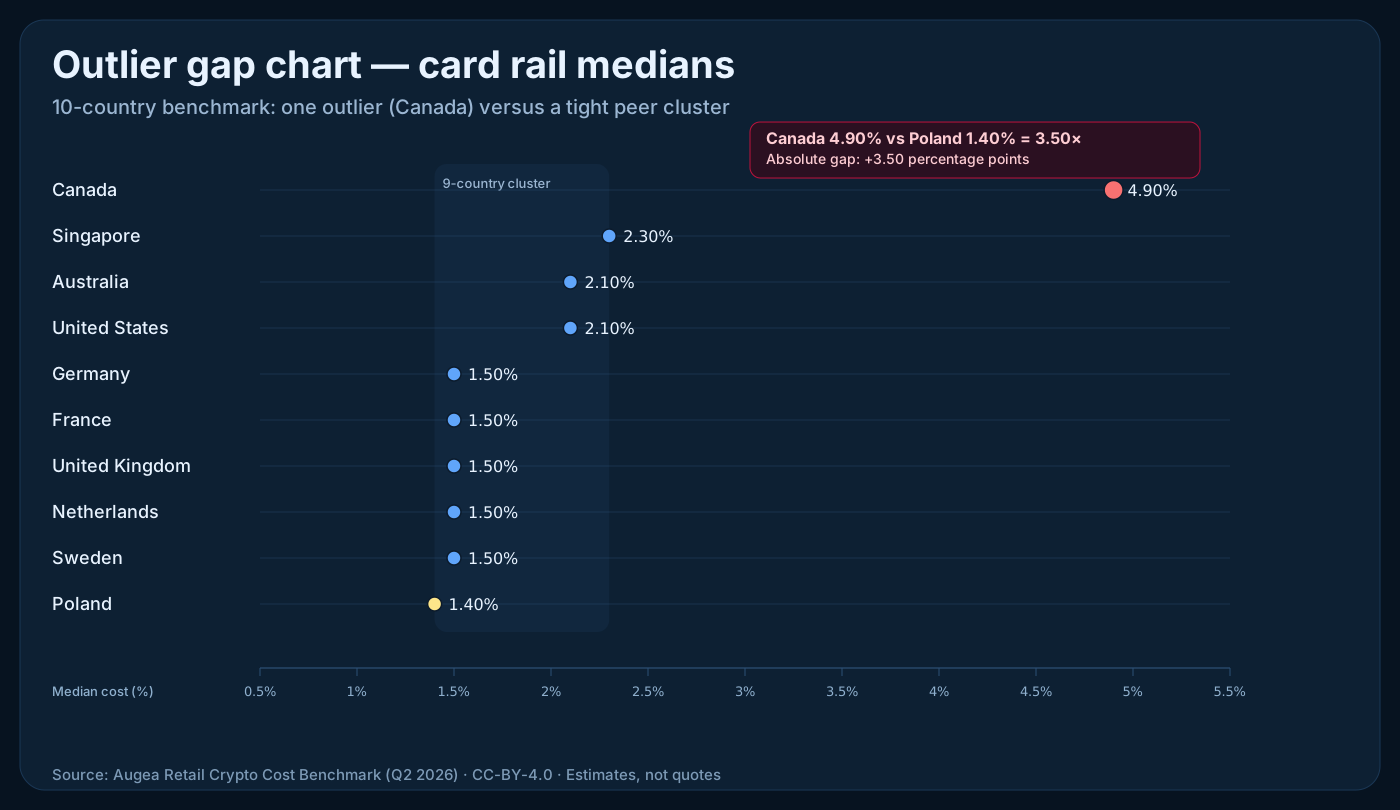
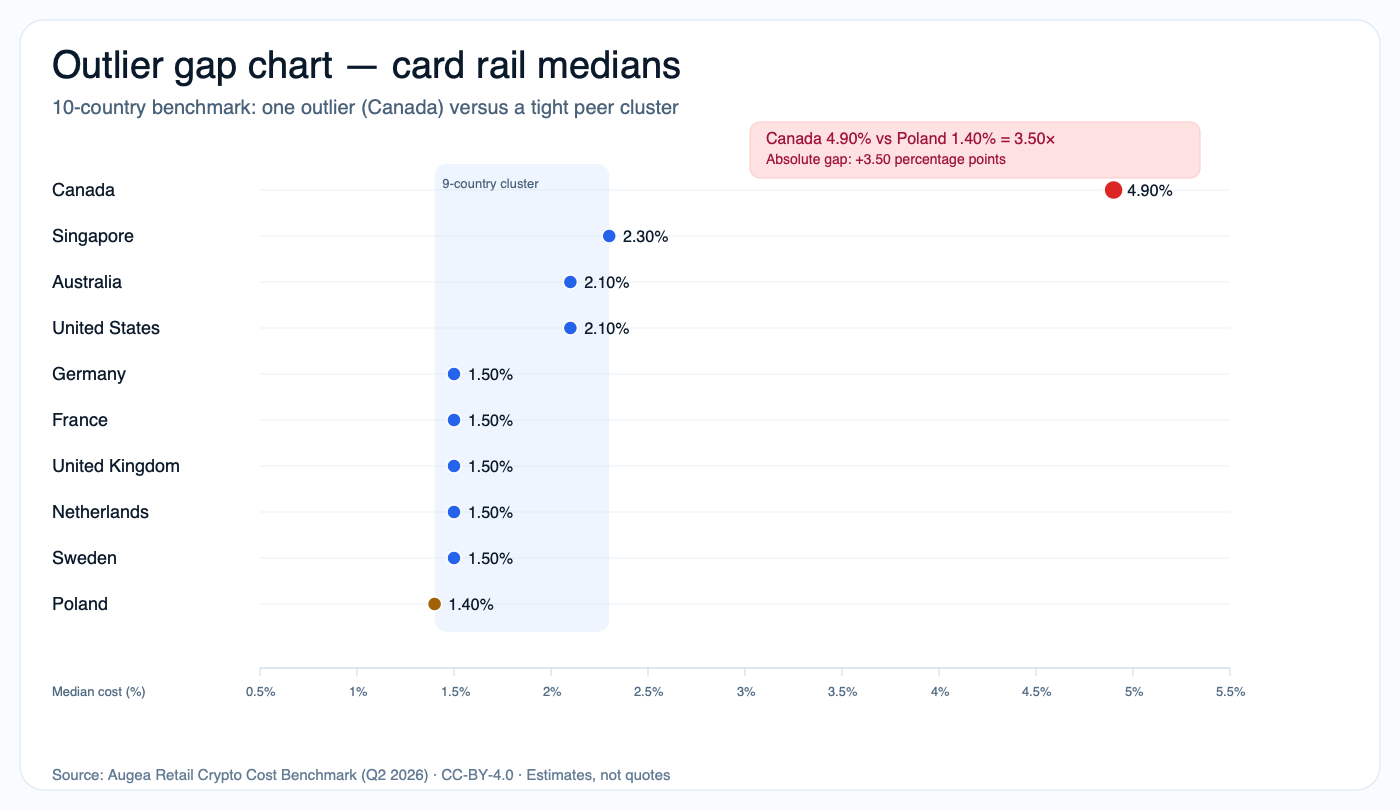
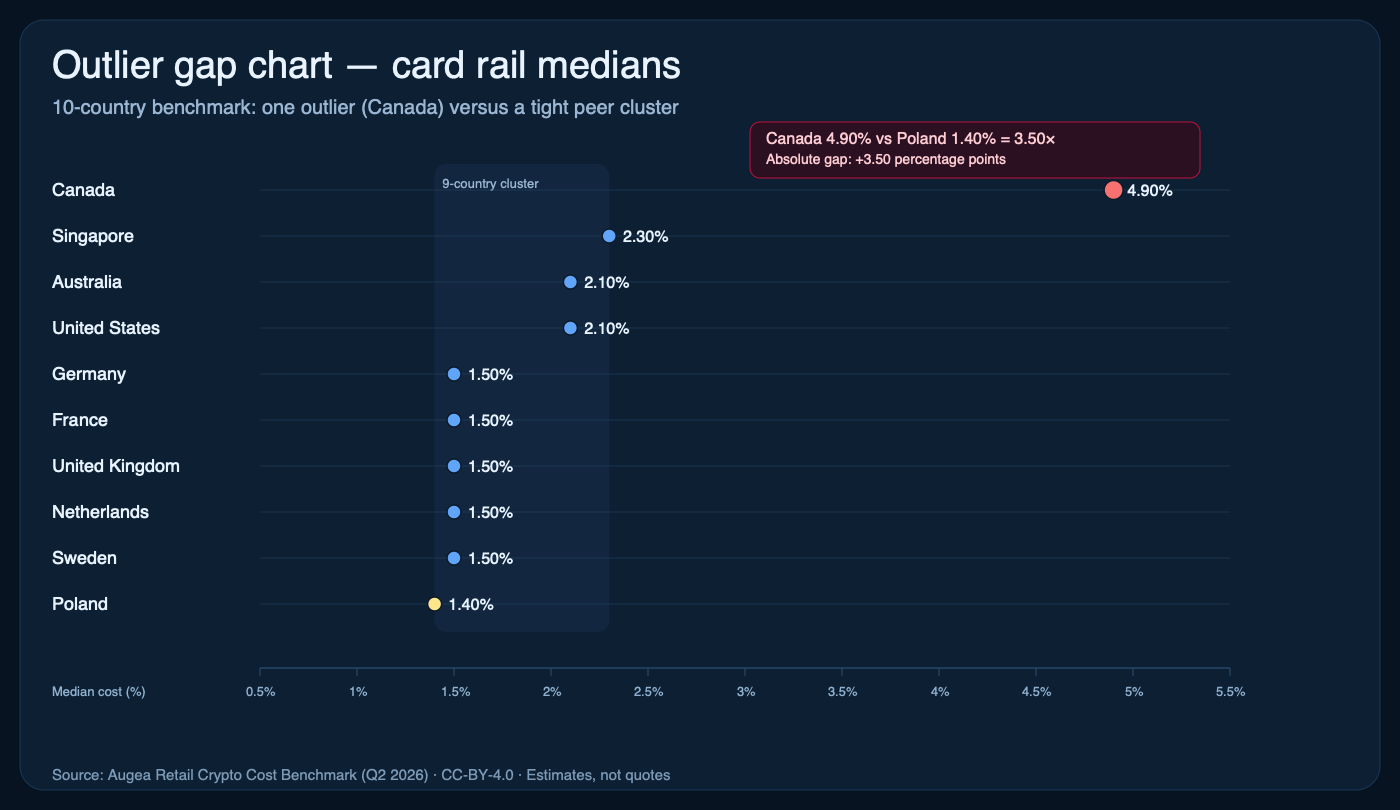
Outlier gap chart (card rail)

One-country outlier versus the 9-country cluster on a shared axis. This is the fastest visual read of the headline finding.

Outlier chart showing Canada as a clear cost outlier versus a tight 9-country cluster on card-rail medians.
SVGPNG darkPNG whitealt · Outlier chart of card-rail median cost across 10 tracked countries.

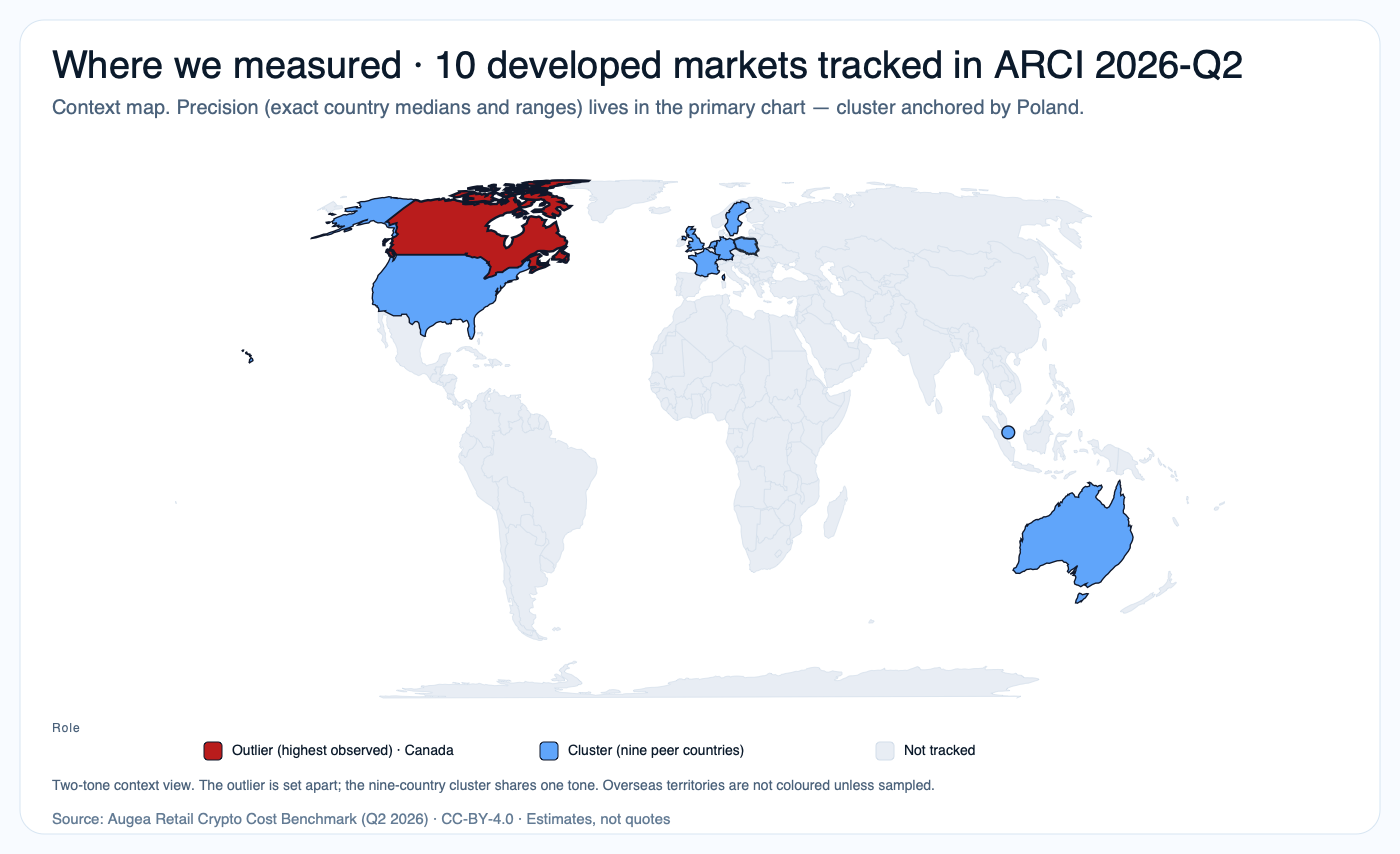
Geographic context

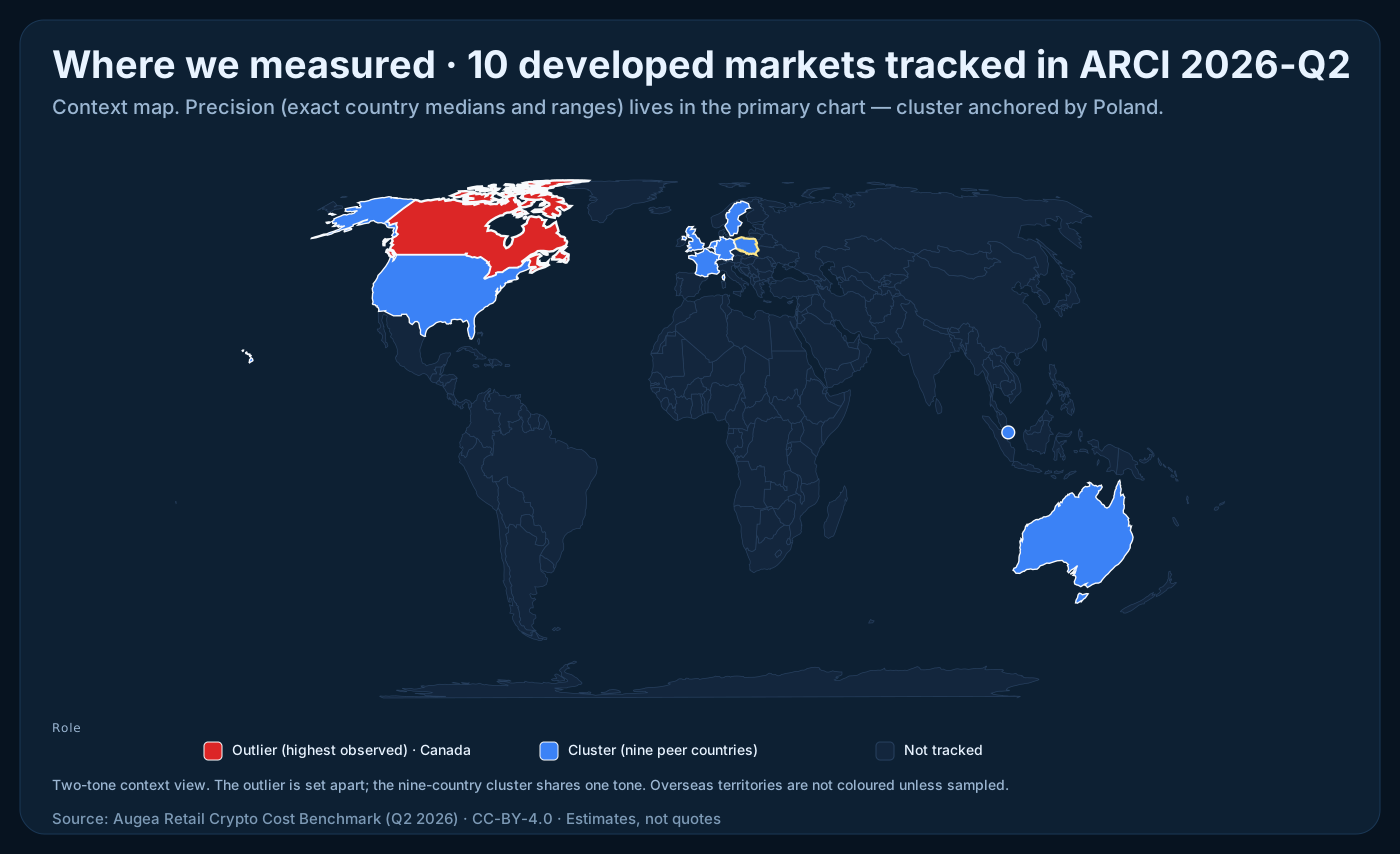
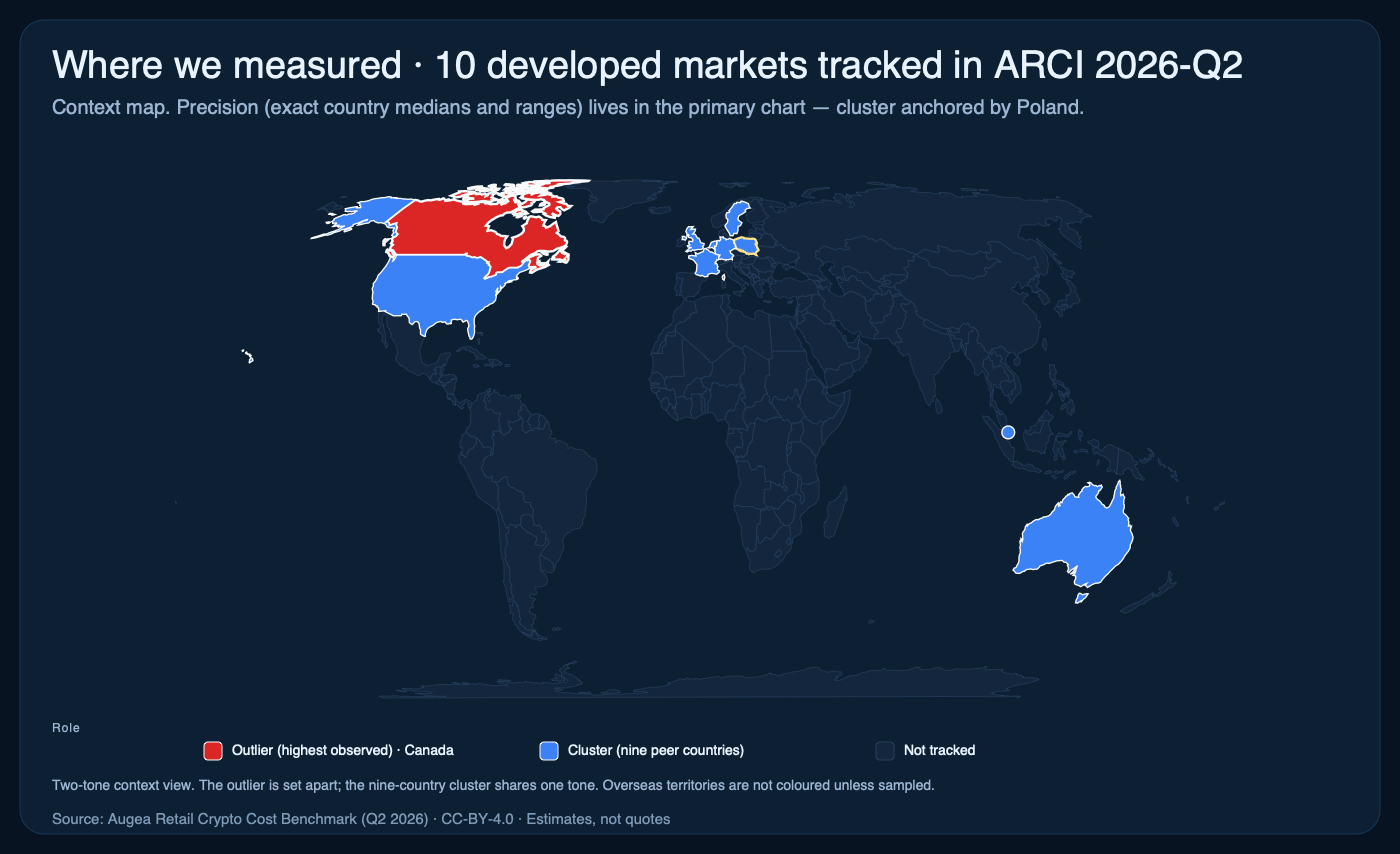
World map context + exact country medians

Secondary · share asset

The map is intentionally context-first (where countries sit). Use the value panel for exact medians and ranges.

Measured markets are interactive. Drag the map to pan; use zoom buttons or a scroll wheel. Tap a highlighted country for details.

Country boundaries: Natural Earth 110m (public domain). Map is geographic context; exact medians are in the table.

Select a highlighted country on the map to see card-rail median, range, and comparable asset count from this benchmark slice.

SVGPNG darkPNG whitealt · Full world map of card-rail median cost across tracked countries.

Need white-background exports for editorial republish? Use the press page.

Cite and reuse

This benchmark is released for editorial and research reuse under CC-BY-4.0, with the full methodology and machine-readable appendix files linked below.

Preferred citation

Augea, The Retail Crypto Cost Gap — Country Benchmark (Q2 2026), https://augea.io/reports/retail-crypto-cost-benchmark-2026-q2, accessed [DATE].